
Published: February 2019
Nawroos Shibli
Drawing from a nationwide survey of 888 youth participants of Arab descent, along with focus group data with 200 youth in the cities of Montreal and Ottawa, this brief will analyze the breadth, depth and complexities of identity formation among Arab youth in Canada, including how they negotiate their sense of belonging between Eastern (Arab) and Western (Canadian) cultures. This brief shows that Arab youth are well integrated into Canadian society and subscribe to hyphenated identities that, in essence, take the best of both worlds/cultures. The Arab youth experience with integration can help inform Canada’s multiculturalism policies as they relate to newcomer settlement and integration of Arab immigrant communities and can be extended to other ethnocultural minority populations.
KEY FINDINGS
- Arab youth in Canada subscribe to hyphenated or dual identities.
- They negotiate their identities between different cultures (Eastern/Western and Arab/Canadian) by retaining what they deem positive values from each culture.
- Arab youth buy into Canadian multiculturalism and integration.
- The experiences of Arab youth, especially those who immigrated to Canada, suggests that the transition into Canadian society could be made easier by building cultural connections.
- Research shows that collaboration and inclusion of ethnocultural organizations in the settlement process helps bridge cultural gaps, encourages positive identity formation and integration into Canadian society; despite this, the Canadian government has consistently reduced funding for ethnocultural organizations and the immigrant settlement services they provide.
INTRODUCTION
Arabs comprise the largest influx of immigrants to Canada. By 2023 the Arab community is expected to grow in size by 200%
Canada, a country that prides itself on its emphasis of multiculturalism, inclusivity and diversity, has an immigrant population of 21.9% or 7.7 million people who come from or were born in 200 different countries and speak an equally wide array of different languages.[1] Indeed, the highest number of immigrants to Canada between 2011 and 2016 were from Asia, including the Middle East.[2] Of this number, Arabs comprise the largest influx of immigrants to Canada.[3] Canadians of Arab descent and ancestry represent a population size of 523,235 people, almost doubling in size over the last ten years, and are the second fastest-growing ethnocultural group in Canada.[4] They also comprise the second largest visible minority group in the cosmopolitan cities of Montreal and Ottawa-Gatineau and the second youngest visible minority group with a median age of 30.2 years old.[5] Trends continuing as they are, Statistics Canada projects that by 2036 up to 39%-49% of all Canadian children will be of immigrant background;[6] in tandem, the Arab community is expected to grow in size by 200% by this time![7] Yet despite this, Arab youth are one of the most understudied demographic populations in the country.[8] With such a huge growth in racialized populations in Canada, especially with the drastic population growth of ethnocultural groups due to high immigration rates as is the case with Arabs, it is important for Canada to be well equipped to assist and ease the transition and settlement processes for newcomers. It is imperative to understand the experiences, identity formation processes, levels of acculturation/enculturation,[9] sense of belonging, and value subscriptions of immigrant youth – and in this case, of Arab youth in particular – not only because they act as a cultural bridge between adult immigrants and the wider population but also because their levels of integration will influence their stake and role in Canadian society and can help bolster Canada’s multicultural national identity.[10]
A recent nationwide study of Arab youth revealed that this demographic not only negotiates their identities between their ethnic Eastern culture and the Western culture of their host country, but that they have done so in such a way that does not favour one culture over the other, but instead absorbs values and practices from both.
A recent nationwide study of Arab youth revealed that this demographic not only negotiates their identities between their ethnic Eastern culture and the Western culture of their host country, but that they have done so in such a way that does not favour one culture over the other, but instead absorbs values and practices from both. These youth also embrace Canada’s image of multiculturalism. Despite this general trend, many voiced that their experiences reaching this hyphenated identity could have been improved if they had been provided services connecting them to ethnocultural organizations and already settled immigrants like themselves. They also voiced their yearning for connection with other Arab youth who could relate to and understand their experiences.
Many voiced that their experiences reaching this hyphenated identity could have been improved if they had been provided services connecting them to ethnocultural organizations and already settled immigrants like themselves.
[1] Statistics Canada, “Canada Census Profile, 2016 Census,” Catalogue no. 98-316-X2016001, February 8, 2017, Accessed August 20, 2018, https://www12.statcan.gc.ca/census-recensement/2016/dp-pd/prof/index.cfm?Lang=E; Statistics Canada, “Immigrant Population in Canada, 2017 Census Population,” October 25, 2017, Accessed August 20, 2018, https://www150.statcan.gc.ca/n1/pub/11-627-m/11-627-m2017028-eng.htm.
[2]Statistics Canada, “Immigrant Population by Selected Places of Birth, Admission Category and Period of Immigration, Canada, Provinces and Territories, Census Metropolitan Areas and Areas Outside of Census Metropolitan Areas, 2016 Census,” October 27, 2017, Accessed August 20, 2018, https://www12.statcan.gc.ca/census-recensement/2016/dp-pd/dv-vd/imm/index-eng.cfm. In the last National Household Survey in 2011, Asia (the Middle East included) was also the main region of origin for Canada’s immigrants.
[3] Statistics Canada, “National Household Profile 2011,” Catalogue no. 99-004-XWE, September 11, 2013, Accessed August 20, 2018, https://www12.statcan.gc.ca/nhs-enm/2011/dp-pd/prof/details/page.cfm?Lang=E&Geo1=PR&Code1=01&Data=Count&SearchText=Canada&SearchType=Begins&SearchPR=01&A1=All&B1=All&Custom=&TABID=1.
[4] Gloria Galloway, Dakshana Bascaramurty, and Allan Maki, “Canada Getting More Diverse as Immigration, Indigenous Population Increase,” The Globe and Mail, October 25, 2017, https://www.theglobeandmail.com/news/national/census-2016-highlights-diversity-housing-indigenous/article36711216/; Statistics Canada, “Canada Census Profile, 2016.”
[5] Tina Chui & Thomas Anderson, “Immigration and Ethnocultural Diversity in Canada,” Catalogue no. 99-010-X2011001, 2013, https://www12.statcan.gc.ca/nhs-enm/2011/as-sa/99-010-x/99-010-x2011001-eng.pdf.
[6] René Houle and Hélène Maheux, “Census in Brief: Children with an Immigrant Background: Bridging Cultures,” Ottawa, October 25, 2017, https://www12.statcan.gc.ca/census-recensement/2016/as-sa/98-200-x/2016015/98-200-x2016015-eng.cfm.
[7] The Canadian Press, “Census 2016: Canada’s Diversity Showcased with Hundreds of Household Languages,” Global News, July 31, 2017, Accessed December 1, 2018, https://globalnews.ca/news/3636632/canada-census-data-languages-diversity/.
[8] Paul Eid, Being Arab: Ethnic and Religious Identity Building among Second Generation Youth in Montreal. (Montreal & Kingston: McGill-Queen’s University Press, 2007), ix. The lack of ethnocultural data on the experiences of Arabs/Middle Eastern peoples is not limited to Canada; there is also scant information on the United States’ Arab/Middle Eastern population (Awad, "The Impact of Acculturation," 59).
[9] Acculturation is the process by which two or more cultures interact with one another, and the dominant culture is fully embraced and adopted (Awad, "The Impact of Acculturation," 60; Paterson & Hakim-Larson," Arab Youth in Canada," 207). Enculturation, on the other hand, refers to the opposite processes whereby one identifies most with their “culture of origin or ethnic group” (Paterson & Hakim-Larson, "Arab Youth in Canada," 207).
[10] Marian J Rossiter, Sarvenaz Hatami, Dan Ripley, and Katherine R Rossiter, “Immigrant and Refugee Youth Settlement Experiences: ‘A New Kind of War,’” International Journal of Child, Youth & Family Studies 6, no. 4.1 (2015): 751, https://doi.org/http://dx.doi.org/10.18357/ijcyfs.641201515056; Houle & Maheux, “Census in Brief.”
Findings: Canadian Arab Youth Demographics & Identity Experiences
A bad way to look at [it] is as two separate identities. Rather look at it as one identity. An identity just comes down to the person of how you are [sic]. One thing I kind of got a lot of…when I came here was how I integrated...Because I do have the values I take from here, and [t]here. There are lessons you can learn from here as well [as] lessons from there. You just have to mix it, and that is what your identity is at the end. So just having the whole Canadian and Arab identity as two separate things is not really a good way to look at it.[11]
- Focus Group Respondent, Ottawa, on the compatibility of Arab and Western identity
The data that informs this brief is pulled from a recent 2016 survey questionnaire of Arab youth from across Canada. In addition to the national quantitative results, qualitative data was garnered through focus groups sessions of six to eight youth per session in two Canadian cities (Ottawa and Montreal) with 100 participants in each city, for a total of 200 focus group participants. This study gathered 973 survey responses from individuals of Arab descent.
Because the focus of this brief is on youth, only data from those people between the ages of 0-17, 18-24, and 25-29 years of age is included which brings the sample size down to 888 respondents. Of this number, 413 are female, 430 are male, 42 chose not to specify, while 3 identified as other. The majority of respondents in all gender groups were between the ages of 18-24. With regards to religious affiliation, 75% were Muslim, 12% were Christian, while 7% identified with other religions and 6% did not respond.
Of the 888 youth respondents, more than half (58.3%) were born outside of Canada, while just over one-third (33.2%) were born here; 8% (75 respondents) declined to answer. This echoes findings from the 2011 National Household Survey which showed that of Canada’s visible minorities, 30.9% were born inside the country, while 65.1% were not and had immigrated to Canada.[12]
[11] Focus Group Respondent, Ottawa, November/December 2016.
[12] Chui & Anderson, “Immigration Ethnocultural Diversity.”
Self-Identity – Between Eastern and Western Cultures
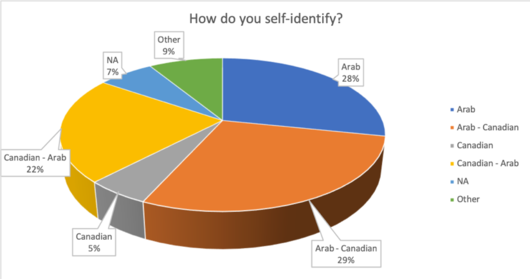
When respondents were asked how they self-identified, just over half embraced a hyphenated identity as outlined below: 29% identify as Arab-Canadian, suggesting that they identify first with their ethnic identity and then with the national identity of being Canadian, while 22% identified as Canadian-Arab. Of course, survey results cannot shed light on the slight nuances between these different categories, but it still highlights the dual nature of identity preferences among young Arabs.
These youth preserve their ethnic identity by staying connected to their culture through social media, by listening to Arabic music and watching Arab television shows, maintaining their language skills, and staying in touch with family and friends in their country of origin. Indeed, many youths listened to cultural music or watched Arab television partly to help nurture their language proficiency and retain bonds with their cultural heritage, not wanting to lose these essential links to their ethnic roots and identity. A common thread amongst participants who were born outside of Canada and lived part of their lives in the Middle East/North Africa was that connecting to their roots and sustaining relations with their country of origin was easier, whereas those born in Canada felt that retaining transcultural connectivity required more of an effort. Regardless, it is clear that Arab youth overwhelmingly wish to maintain aspects of their ethnic identity, especially their fluency in Arabic, which for many represented a critical and definitive aspect of their identity.
In this vein, several focus group participants spoke of their experiences navigating their dual identities, insisting that their Eastern and Western cultures are compatible and should not be viewed as two disparate choices:
The Arab culture itself is not a perfect culture and the Western culture itself is not a perfect culture. There are goods that we can take from here and goods that we can take from there… I don’t see any of us here agreeing fully with the Arab culture or fully with the Western culture. We have a little bit of both.[13]
Identity is a personal choice and most ethnic minorities choose to endorse a dual identity which is constantly negotiated.
Others echoed this sentiment, asserting that the discourse surrounding identity formation, which presses young Arabs to choose one identity over the other, is detrimental and constraining: “A bad way to look at is as two separate identities. Rather look at it as one identity,”and “It feels like…they want me to choose between a nationality and identity…Frankly, it’s both!...It’s not one identity that characterizes a person.” [14] Participants discussed the merits of subscribing to a hybrid identity not only because it allowed them to “get the best of both cultures,”[15] but because it also allowed them to share understandings and perspectives of both cultures at the same time, which was viewed as a positive ideal. As one Ottawa respondent summed up: “…I’m combining two cultures together, my Canadian culture and my Arab culture. I don’t feel connected with that [one culture over the other]. I feel connected with the mix of the Canadian-Arab.”[16] Interestingly, these experiences are not dissimilar to Arab-American youth who also seem to straddle the dynamic, everchanging and fluid identity division between being Arab and identifying with Western culture.[17] Nevertheless, one thing is evident: identity is a personal choice and most ethnic minorities choose to endorse a dual identity which is constantly negotiated.
[13] Focus Group Respondent, Ottawa, November/December 2016.
[14] Focus Group Respondent, Ottawa, November/December 2016; Focus Group Respondent, Montreal, November/December 2016.
[15] Focus Group Respondent, Ottawa, November/December 2016.
[16] Focus Group Respondent, Ottawa, November/December 2016.
[17] Thea Renda Abu El-Haj, “Imagining Postnationalism: Arts, Citizenship Education, and Arab American Youth,” Anthropology and Education Quarterly 40, no. 1 (2009): 7, https://doi.org/10.1111/j.1548-1492.2009.01025.x.
Best of Both Worlds: Borrowing Values
Part and parcel of their hybrid identity formation, Arab youth discussed how they embrace values from both their ethnic Eastern culture and their adopted Western culture. A participant who immigrated to Canada at the age of eighteen described this phenomenon: “Coming here and travelling the world and living a huge part of my life out of my original culture made me realize…different perspectives and different cultures and habits… [Y]ou compare and see which one is good and bad; you can pick and choose. I would say there is a lot in both cultures and there is a lot of nice habits.”[18] Some of these positive values that they wish to retain from their Arab culture include: strong familial ties, respect for elders, strong sense of community, hospitality, Arab music, food and cultural traditions, religion, and their mother-tongue. Positive Western values that they embrace are: gender equality and women’s rights and greater tolerance and acceptance. As such, this cross-cultural negotiation allows youth to form well-rounded, hybrid identities that allow them to mix and integrate their ethnic beliefs with Western values.
This cross-cultural negotiation allows youth to form well-rounded, hybrid identities that allow them to mix and integrate their ethnic beliefs with Western values.
Indeed, Arab youth, including those is this survey, overwhelmingly buy into and support the ideology that is Canadian multiculturalism.[19] As one participant aptly described:
…in Canada, [I] can express my Arab identity along with my Western identity in a society that is very multicultural. I can come to events like this and speak only in my home language; at the same time, I can walk 30 seconds outside and be in a completely different Western world and express my own Western, or Western adopted, identity simultaneously. I don’t think it can really be exclusive to one or the other.[20]
[18] Focus Group Respondent, Ottawa, November/December 2016.
[19] Mehrunnisa Ahmad Ali, “Second-Generation Youth’s Belief in the Myth of Canadian Multiculturalism,” Canadian Ethnic Studies 40, no. 2 (2008): 91 & 99, https://doi.org/10.1353/ces.2010.0017.
[20] Focus Group Respondent, Ottawa, November/December 2016.
Sense of Belonging
Related to this, of the 888 youth respondents, 30.6% felt extremely at home, 34.2% felt moderately at home, 1.5% felt not at all at home in Canada, 6.2% felt slightly at home in Canada, and 22.1% felt somewhat at home in Canada. Of those who felt extremely at home in Canada were those who identified as Canadian-Arab with 105 respondents, representing 38.6% of the “extremely at home” responses.
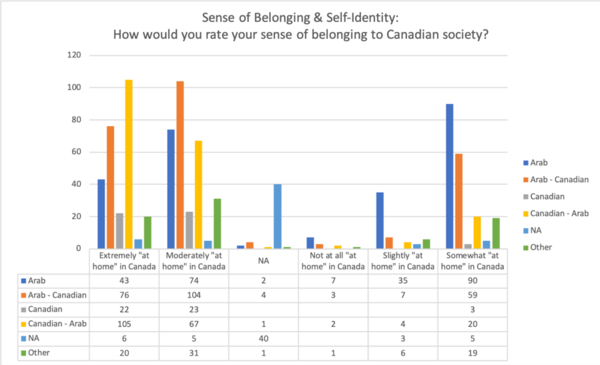
Though it is hard to say whether there is a definitive correlation between one’s sense of belonging and how they self-identify, a cross-table analysis highlights who felt the most at home in Canada:
- 17.1% of Arabs felt extremely at home in Canada.
- 30% of Arab-Canadians felt extremely at home in Canada.
- 45.8% of Canadians felt extremely at home in Canada.
- 52.8% of Canadian-Arabs said that they felt extremely at home in Canada.
The respondents who felt the most at home in Canada were those who identified first as Canadian (Canadian-Arabs and Canadians) and then as Arab. Of course, 41.1% of Arab-Canadians felt moderately at home (meaning they felt slightly less at home than those who identified as Canadian or Canadian-Arab, but still felt relatively comfortable nonetheless). Arabs represented the highest number of those who felt only “slightly,” “somewhat,” and “not at all” at home in Canada. The above graph indicates that those youths who maintained their ethnic identity and simultaneously adopted the culture of their host country– ie. the Arab youth who embraced a dual identity – felt the most at home in Canada, suggesting that there is stated value in encouraging the cultivation of ethnic identity as it fosters stronger sentiments of belonging to the country and to the Canadian national identity.
Strong ethnic connections promote diversity and enables smoother transitions into the host country
Though the mild differences between these categories of belonging are more nuanced than anything, previous research shows that certain factors can influence one’s sense of belonging in a country that is not their nation of origin. In this case and from focus group responses, the strength of one’s familial ties here in Canada and their connections to and friendships with other Arabs, along with their socialization in the wider host community, impacts how “at home” respondents feel in Canada. These factors, especially the attachment to ethnic community, reflects the literature on ethnic communities’ sense of belonging in a host country; strong ethnic connections promote diversity and enables smoother transitions into the host country.[21]
Related to this are desires for greater intergroup connection. Several participants, especially those who arrived in Canada as immigrants, explained how the first thing they sought upon arrival were other Arabs, people who they could culturally and linguistically connect with and relate to: “I found that right when we came here, that’s the first thing that we wanted: to meet lots of Arabs. And then you will eventually integrate within the city. But that first starter point, you need to meet a lot of Arabs [sic].”[22] These youth yearned for bonds to their home base with people who could better understand the values and barriers they were experiencing, not only as a means of comfort but as a means of facilitating their integration into a new, foreign society.
Arab youth seem to be well integrated into Canadian society. They wish to maintain their cultural heritage and mother tongue while adopting and retaining Canadian, Western values
In sum, Arab youth seem to be well integrated into Canadian society. They wish to maintain their cultural heritage and mother tongue while adopting and retaining Canadian, Western values, and practicing hybridized identities that equally embraces both cultures. They also seek connections with other Arabs for familiarity and practical reasons.
Still, Arab youth sometimes have difficulty straddling two cultures, which results in feelings of not belonging fully to either culture. When they visit their home country of origin they are asked where they are from, and when they are here in Canada they are asked where they are from, which leaves them feeling as if they do not belong anywhere.[23] Although this can lead to negative feelings of cultural homelessness, others see this as a positive aspect: they do not have to stick to one identity and can constantly negotiate and shift their identity to fit where they are located geographically or who they are with at the time. Identity becomes a dynamic, temporal and fluid choice influenced by the social spaces and geographic places one is located in or experiencing.
It must be noted, however, that there are differences within Arab cultures on several levels (national, geographical, tribal, etc.) and that this ethnic community is not monolithic. This sentiment was voiced by participants who mentioned that they felt more attached to their country of origin than to Arab culture and that there exist great variances across Arab countries and peoples. As one respondent aptly put it: “When we think about Arabs, we think of it as [an] umbrella term. We don’t see it that way – it’s so specific and personal, everyone interprets their “Arabness” in their own way.”[24]
There are a lack of services to connect Arab youth with ethnocultural groups upon arrival to Canada to help them build meaningful relationships, promote a positive sense of belonging, and ease the integration process into Canadian society while maintaining the comforts of their heritage.
This study shows variations of what has already been found in other surveys of this demographic in terms values, identity formation and integration; a new theme that becomes apparent is that there are a lack of services to connect Arab youth with ethnocultural groups upon arrival to Canada to help them build meaningful relationships, promote a positive sense of belonging, and ease the integration process into Canadian society while maintaining the comforts of their heritage.
[21]Sinela Jurkova, “The Role of Ethno-Cultural Organizations in Immigrant Integration: A Case Study of the Bulgarian Society in Western Canada,” Canadian Ethnic Studies 46, no. 1 (2014): 25 & 40, https://doi.org/10.1353/ces.2014.0005; John McCoy, Anna Kirova, and W. Andy Knight, “Gauging Social Integration among Canadian Muslims: A Sense of Belonging in an Age of Anxiety,” Canadian Ethnic Studies 48, no. 2 (2016): 39, https://doi.org/10.1353/ces.2016.0012.
[22] Focus Group Respondent, Ottawa, November/December 2016.
[23] Focus Group Respondent, Montreal, November/December 2016.
[24] Focus Group Respondent, Ottawa, November/December 2016.
Canadian Multiculturalism: Current Processes, Policies, and Gaps
Multiculturalism has been an ideological staple of Canada’s national and international image for decades. Realized through the practice of immigration and officially established in 1971 under the Prime Ministership of Pierre Trudeau, the purpose of the policy was, and continues to be, four-fold:
1) assist cultural groups with their cultural development; 2) help members of cultural groups to overcome cultural barriers to full participation in Canadian society; 3) promote creative encounters and interchange among all cultural groups in the interest of national unity; and 4) help immigrants to acquire at least one of Canada’s official languages.[25]
In addition to this, the policy is also meant to encourage diversity, accommodate cultural difference, safeguard minority rights, provide and justify state sponsored programming for minority groups, and promote an inclusive society overall.[26] With this policy, Canada officially recognized the importance of preserving cultural heritage.[27] As such, integration was intended, in part, to encourage the maintenance of one’s distinct ethnic identity.
Government services tend to offer a “difference-blind approach” which operates on the basis that people have the same basic needs which require the same service solutions regardless of cultural differences or ethnic identities.
Despite what seems like a holistic and well-rounded approach on paper, in practice government services tend to offer a “difference-blind approach” which operates on the basis that people have the same basic needs which require the same service solutions regardless of cultural differences or ethnic identities.[28] This means that ethnic difference is not taken into consideration in the provision of settlement services for immigrants or refugees. This is not to say that mainstream organizations do not offer culturally sensitive services or incorporate multiculturally based programming; indeed, settlement agencies have endeavored to do so in order to make their services more accessible.[29] However, services curated for minorities are offered on a case by case basis rather than being systematically offered or cohesively tied into organizational structures or policy agendas.[30] As such, there remains room for improvement in helping newcomers navigate and integrate into Canadian society.
Although there do exist ethnocultural organizations which provide social services, they are severely underfunded. Despite an increase in federal budgets for immigration settlement and because of the general trend towards mainstreaming the facilitation of services, monoethnic organizations which aim to service specific ethnic or cultural communities tend to be marginalized by the federal government in terms of funding.[31] The majority of funding is directed to broad-based multiethnic agencies that do not target specific communities.[32] With regards to the community focused on in this brief, there do exist organizations with a specialty in serving newcomers of Arab descent such as the Arab Community Centre of Toronto (ACCT), but over time (and likely due to the overwhelming demand associated with large influxes of newcomers coupled with the need for funding) they have expanded their portfolios to wider communities and demographics.[33]
Monoethnic organizations which aim to service specific ethnic or cultural communities tend to be marginalized by the federal government in terms of funding.
It is clear that community organizations are very important for new immigrants[34] so this disinclination to financially support ethnically homogenous institutions despite the benefits of their culturally curated services and relationship building potential highlights the superficiality of Canada’s multiculturalism policies. Not only do ethnically specific organizations promote democracy and equality, they also encourage communities to interact with other groups in society; the maintenance of ethnic identity helps mitigate any negative experiences newcomers have outside their cultural communities and, as such, form a healthy sense of well-being.[35]
Not only do ethnically specific organizations promote democracy and equality, they also encourage communities to interact with other groups in society.
These organizations have been quite successful at meeting and addressing the needs of new immigrants quite effectively and efficiently because of the shared identities, barriers and connections they have in common. Despite a proven track record of success, racially specific organizations have been criticized for promoting ghettoization and entrenching marginalization by isolating ethnic communities from interacting with mainstream organizations; however, studies have consistently proven that these criticisms are unfounded.[36] Research conducted on Chinese ethnic organizations (such as the ASSIST Community Services Centre, formerly the Edmonton Chinese Community Services Centre, and the Calgary Chinese Community Service Association) and the Bulgarian community in Western Canada shows that the inclusion of ethno-racial agencies in the immigration settlement landscape not only provides more equitable services, but also positively influences one’s sense of belonging to the country and enables a smoother transition into Canadian culture.[37] Former Vice-Chair of ASSIST responded to the above listed criticisms and highlights the importance of financial support with the following statement:
The inclusion of ethno-racial agencies in the immigration settlement landscape not only provides more equitable services, but also positively influences one’s sense of belonging to the country and enables a smoother transition into Canadian culture.
…The fact of the matter is, when newcomers come, they need psychological and social support. If they don’t have our support, it can be a problem. I think we offer services to assist them to achieve integration. It just makes them much better to go to the mainstream. So actually I think the funding agencies have a very good return on their investment, on their funding.[38]
The overall findings of these studies show that “ethno-racial organizations were more effective than mainstream organizations because they were more closely connected with and responsive to the ethnic community’s needs.”[39] As such, it seems that current settlement processes do not include or emphasize ethnocultural organizations and disregard newcomers’ wishes for more cultural connections as outlined by youth in the focus group data.
Current settlement processes do not include or emphasize ethnocultural organizations and disregard newcomers’ wishes for more cultural connections.
[25] Shibao Guo and Yan Guo, “Multiculturalism, Ethnicity and Minority Rights: The Complexity and Paradox of Ethnic Organizations in Canada,” Canadian Ethnic Studies 43, no. 1 (2011): 61, https://doi.org/10.1353/ces.2011.0023.
[26] Ali, “Second Generation Youth,” 91 & 92; Guo & Guo, “Multiculturalism, Ethnicity and Minority Rights,” 78; Marie McAndrew, Denise Helly, Caroline Tessier, and Judy Young, “From Heritage Languages to Institutional Change: An Analysis of the Nature of Organizations and Projects Funded by the Canadian Multiculturalism Program (1983-2002),” Canadian Ethnic Studies 40, no. 3 (2008): 155 & 156.
[27] Yujiro Sano, Lisa Kaida, and Eric Y Tenkorang, “Racial Variations in Ethnic Identity Among the Children of Immigrants in Canada,” Canadian Ethnic Studies Journal 47, no. 3 (2015): 50, https://doi.org/10.1353/ces.2015.0030.
[28] Guo & Guo, “Multiculturalism, Ethnicity and Minority Rights,” 68.
[29] Ibid.
[30] Ibid.
[31] Philippe Couton, “Ethnocultural Community Organizations and Immigrant Integration in Canada,” IRPP Study June, no. 47 (2014): 1 & 20.
[32] Couton, “Ethnocultural Community Organizations,” 20; McAndrew et al., “From Heritage Language to Institutional Change,” 156.
[33] Arab Community Centre of Toronto, “ACCT: About Us,” Accessed September 18, 2018,
[34] Couton, “Ethnocultural Community Organizations,” 4.
[35] Jurkova, “The Role of Ethno-Cultural Organizations,” 27.
[36] Guo & Guo, “Multiculturalism, Ethnicity and Minority Rights,” 62 & 76; McAndrew et al., “From Heritage Language to Institutional Change,” 166.
[37] See Guo & Guo, “Multiculturalism, Ethnicity and Minority Rights” and Jurkova, “The Role of Ethno-Cultural Organizations,” respectively, for detailed results of ethnocultural studies.
[38] Guo & Guo, “Multiculturalism, Ethnicity and Minority Rights,” 76.
[39] Ibid., 68.
Recommendations
If Canada wishes to maintain and strengthen its national identity and international reputation as a colourful, multicultural mosaic, it must offer substantive – and not superficial – changes by effecting inclusive policy and action that is ethnically aware and culturally sensitive.
Given the above findings, the following policy actions are recommended for implementation by the federal government of Canada, and Immigration, Refugees and Citizenship Canada in particular, along with provincial governments who facilitate related policies within their jurisdictions:
1. Place greater emphasis on and provide more funding for ethnocultural organizations as facilitators and service providers in the immigration settlement processes.
The experiences of these youth, especially those who immigrated to Canada, suggests that emphasis during the settlement process should be placed on building cultural connections within their ethnic community, which in turn helps bridge connections with the wider Canadian society.
Emphasis during the settlement process should be placed on building cultural connections within their ethnic community, which in turn helps bridge connections with the wider Canadian society.
To assist in navigating the strange and foreign landscapes of a new country, along with the social, psychological and civic needs that come with it, there should be stated efforts and programming which connects and introduces newcomer Arabs to Arabs who have been settled in the country and/or lived here for a long time. Despite criticisms that may target these suggested policies as being detrimental to collective national identity formation, promoting ghettoization and undermining democracy and equality, research illustrates that ethnocultural organizations actually add value to and ease the transition for integrating into Canadian society and also improves the organizational capacities of ethnic groups.[40] A public policy shift and the associated normative swing in this direction would legitimize Canada’s priority of maintaining and encouraging salad bowl multiculturalism over melting pot politics.
In the case of Arab populations, the meaningful inclusion of Arab-run agencies with native Arab speakers and people who understand the struggle of identity formation, resettlement, navigating between cultural and lifestyle differences, along with the associated benefit of connecting them to others in their community, can improve their sense of belonging and well-being in Canada.[41] Accessibility to programs such as English language classes, courses on Canadian civics, legal aid, and other referral programs can increase the success of integration as has been the case in similar organizations, especially when provided by individuals who can culturally relate.[42] Of course, this is not to say that ethnocultural organizations would deny service to people from outside the ethnic group, but that ethnically sensitive support would be available to them if needed; simply having a more substantive and thoroughly integrated multicultural approach to settlement services would improve current practices to meet the needs of newcomers.
As such, the federal government should increase their funding budget for these organizations rather than scale them back as has been the trend over the last few years, and provincial governments should facilitate them in a way that reflects the demographics of their ethnic minority populations.
2. Encourage volunteerism among youth, especially within ethnocultural organizations.
Part and parcel of the success of ethno-specific organizations has been the role that volunteers play in providing support for programs which foster multicultural approaches to service provision. As was the case with Chinese organizations in Western Canada, the inclusion of youth and volunteers was integral to making services accessible to the immigrant community. For example, they acted as child care providers, language interpreters, administrative assistants, youth mentors and fundraising officers, which not only supported the immigrant community but the organization itself in filling staffing gaps; many of these volunteers ended up working within these institutions in managerial roles later on.[43] Furthermore, concerted efforts which promote volunteerism would not only help youth build cultural connections and promote civic values of community engagement, but would also assist in the development of other social skills such as leadership, communication and problem-solving.[44] Indeed, other studies on immigrant youth highlighted how having mentors and access to people with similar experiences could alleviate the social and psychological stress of adapting to a new society and could also help with positive identity formation and sense of belonging.[45]
Involving youth in these organizations could help provide a more targeted and holistic approach to the needs of immigrant communities in Canada.
Taking into consideration that immigrant youth appreciate relationship building within their ethnic communities upon arrival to Canada, along with the effectiveness of monoethnic settlement services, it follows that involving youth in these organizations could help provide a more targeted and holistic approach to the needs of immigrant communities in Canada.
3. Further research on Arab youth as a demographic should be pursued in order to better understand their needs and experiences.
Research on visible minority youth in general is extremely important moving forward considering the projection that two decades from now, a substantial segment of Canadian youth will be of immigrant background.
Needless to say, in order to offer best practices and effectively implement social policies regarding visible minorities and immigrant populations in Canada, further study and research is required. Although the data that informs this brief is quite comprehensive on a national scale for this particular demographic, further ethnographic research is needed. Indeed, research on visible minority youth in general is extremely important moving forward considering the projection that two decades from now, a substantial segment of Canadian youth will be of immigrant background.
Conclusion
Results from this national survey and focus group data can help inform Canada’s multiculturalism policies by supporting ethnocultural organizations and supporting youth volunteerism in these communities.
Although Arab youth seem to have successfully navigated and negotiated their dual identities within Canada, their experiences as newcomers highlights some gaps in settlement processes which can be improved. In order to understand how to better meet their needs, the current immigrant settlement processes must be re-examined. Results from this national survey and focus group data can help inform Canada’s multiculturalism policies by supporting ethnocultural organizations and supporting youth volunteerism in these communities. These organizations help facilitate positive integration into Canadian society and positive association with Canadian values whilst still preserving and encouraging ethnic heritage.
[40] McAndrew et al., “From Heritage Language to Institutional Change,” 165 & 166; Couton, “Ethnocultural Community Organizations,” 18 & 19.
[41] Jurkova, “The Role of Ethno-Cultural Organizations,” 27.
[42] Guo & Guo, “Multiculturalism, Ethnicity and Minority Rights,” 71.
[43] Ibid., 68 & 69.
[44] Rossiter et al., “Immigrant and Refugee Youth Settlement Experiences,” 761 & 762.
[45] Rossiter et al., “Immigrant and Refugee Youth Settlement Experiences,” 751 & 761.
ABOUT THE AUTHOR