
Ola Mohajer
SUMMARY
After winning every one of its Security Council elections for more than 60 years, Canada lost its election in 2010 and is at risk of losing again in 2020. Canada has a proud and distinguished history of contributions to the UN and it is owed it to those who built it before us, Canadians, and to the international community to do better.
It is never too late to strive for excellence regardless of the barriers. With a year left in the race, Canada can reciprocate being a formidable foe to Norway and Ireland. In order to win the UN Security Council election in 2020, the Prime Minister’s Office, Foreign Affairs Minister’s Office, Global Affairs Canada, and the Permanent Mission of Canada to the United Nations must work together to immediately implement the following six recommendations:
- Follow-through on its peacekeeping pledge.
- Increase development assistance.
- Aggressively court Member State electors.
- Vigorously vote swap.
- Employ expert staff and state of the art tools.
- Develop a strong second ballot strategy.
Canada’s 2020 Election and the Importance of Winning a Seat on the UN Security Council
Canada is at risk of losing its election for a seat on the 2021-2022 UN Security Council. The vote is scheduled to take place in June of 2020 at the UN General Assembly (GA) where Canada will vie for one of two seats for a two-year term. The competition is steep as Canada is facing two impressive opponents in Norway and Ireland, both of which are projected to be in the lead.
Any contender running for one of the 10 non-permanent seats on the Council is required to receive a two-thirds majority vote from the 193 Member States of the GA. In 2010, for the first time in its recent history, Canada was unable to receive a two-thirds majority in any round of voting and lost its bid for a seat on the 2011-2012 Security Council. This was an embarrassing blow for the country as it had previously enjoyed a long-standing position of repute and influence due to its many significant contributions to international peace, security, and development through its leadership at the United Nations.
Although the Security Council is the target of consistent and much needed advocacy for reform, its membership remains the most coveted within the United Nations. No other organ or committee draws in such immense interest for a seat at its table. There is also a deep attraction and strategic importance that stems from having the power and authority to influence the world’s most pressing problems.
When Canada takes its seat on the Council, its regional microphone will be replaced with a global megaphone.
Sitting on the Council is a significant step in the pursuit of regaining Canada’s soft power, an ability to shape international decisions spanning from economic to foreign policy through attraction and credibility. Additionally, Canada would be a trusted voice in its share of control over deploying Chapter VII provisions pertaining to threats to peace and how to respond. Sitting on the Council equates to Canada gaining international prestige, political positioning power, and a strong platform for achieving its broader UN and international objectives. When Canada takes its seat on the Council, its regional microphone will be replaced with a global megaphone.
Canada’s 2010 Security Council Election Loss
In the years leading up to the 2010 Security Council election, Canada’s foreign policy including that which concerned peacekeeping and international development took an unprecedented shift. From arms of government, to centers, programs, funding and the like, everything that had been built was either dismantled, minimized, or eliminated. These were key activities in the new foreign policy of Prime Minister, Stephen Harper’s Conservative government (2006-2015).
The foreign policy of the Harper government was very clear in its deprioritization of international organizations and international humanitarian and development work. In this context, five main factors emerge as causes for Canada’s loss in the 2010 Security Council election. These are outlined in the upcoming figure, which begins with the most macro-level factors and moves into the more granular, aiding in the visualization of what led to Canada’s poorly planned and executed campaign.
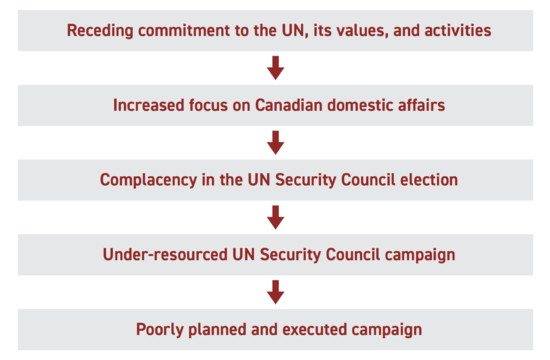
Figure 1: Factors that Caused Canada to lose the 2010 UN Security Council Election
The Harper government differed from the UN on ideological grounds, had different foreign policy interest and activities, approached multilateralism cautiously, and deprioritized international development. This untraditional Canadian foreign policy manifested itself in decreased advocacy and committee work at the UN, limited visits from high-ranking Canadian officials, and the closing of embassies. It also included the determination to continue strict sanctions against Iran when the UN was lifting them, as well as an alienating pro-Israel foreign policy stance. This stance has not changed significantly under the Trudeau government and may cost Canada votes once again.
Outside of the UN’s regular budget, Canada decreased funding to UN-aligned priorities through various other means. Three major examples of many are the closure of the Canadian International Development Agency (CIDA), the longstanding Junior Professional Officers (JPO) program, and the Lester B. Pearson Canadian International Peacekeeping Training Centre. Instead, the Harper government prioritized the majority of its efforts toward domestic endeavors.
With limited UN commitment and a domestic focus, the Canadian government was in no position to make a concerted effort in its Security Council campaign, perhaps making an assumption that the sheer force of values alone would save the day. Canadian Security Council election expert, Dr. David Malone, indicated that strong national repute, as a standalone cannot guarantee success in Security Council elections.
In the face of the foreign policy shift and inward focus, the Permanent Mission of Canada to the United Nations was not granted the financial or human resource capacity required to compete in the 2010 election. Another important compounding variable when it comes to understanding financial allocations towards the 2010 Council election is concerned with Canadian culture.
Canadians impose a great deal of frugality on perceived luxuries when it comes to government spending. If dinners, parties, and gifts cannot be explained to Parliament, and subsequently the Canadian public, then they simply cannot happen. This had a drastic impact on the ability of Canada to court Member States, given that it had to host a series of events and meetings to ensure a successful campaign. The Canadian government was publicly clear that it would not be competing in the 2010 Security Council election by hosting events.
In the aftermath of what cascaded from the Harper government’s foreign policy agenda, Canada’s impressive and decades-long legacy in international development and humanitarian affairs was destroyed in just under 10 years.
In the aftermath of what cascaded from the Harper government’s foreign policy agenda, Canada’s impressive and decades-long legacy in international development and humanitarian affairs was destroyed in just under 10 years. With UN Member States having taken stock or been directly affected by this major shift in Canada’s foreign policy, commitments, and values, it is not surprising that Canada lost its UN Security Council election in 2010.
Barriers to Canada’s Win for the 2020 UN Security Council Election
With the risk of losing another UN Security Council election, it is important to highlight where barriers remain for Canada to compete. It remains to be seen that Canada has implemented the four core campaign elements common between Security Council election winners. Those elements are UN-aligned policy agendas, promises of development assistance, Member State courting, and secretive vote swapping. Some elements are well implemented while others only partially. Canada has done exceptionally well in the design and implementation of a strong policy agenda, however, there are still gains to be made when it comes to development assistance, courting member states, and vote swapping.
Two macro-level barriers to winning the 2020 election necessitate a complete implementation of all four elements. Firstly, the climb back from such a targeted and aggressive downsize is showing to be tremendously difficult. Secondly, the competition is strenuous as Canada faces two very strong opponents in Norway and Ireland.
Foremost, it should be acknowledged that Canada had done well to announce its candidacy early and solidify a very popular policy agenda. Strong thematically based policy commitments are landmarks of successful Security Council campaigns within the Western European and Others Group (WEOG) that Canada is a part of and competes against. Every winner in this race has had to develop a policy agenda in order to win the confidence of the GA.
Canada announced its bid for a 2021-2022 seat on the Council on March 16, 2016, and has since repeated its commitment in Canada, UN meetings and conferences, and to world leaders at the GA. Concurrently, the Canadian government provided the diplomatic community with its policy agenda: Diversity and Inclusion as well as Gender Equality and Empowerment, interlacing them in all other priority areas.
Disheartening but true, Canada’s policy agenda alone will not matter.
Disheartening but true, Canada’s policy agenda alone will not matter. Nevertheless, noteworthy is Canada’s exceptional efforts hereAmong many other activities and commitments on gender equality, it launched “Canada’s National Action Plan 2017-2022 – For the Implementation of UN Security Council Resolutions on Women, Peace, and Security.” This is a clear demonstration of intent to lead and implement. Similarly, both Norway and Ireland have included gender equality and empowerment in their policy agendas and made gains therein.. Norway also launched a similar national action plan shortly after Canada did. Gender equality is a top issue at the UN, so it is rational that all three candidates would prioritize it. Nevertheless, Canada remains the only country in the competition to have a completely feminist foreign policy not to mention one of few in the world.
A few more highlights on the formidable competition illustrate why it is a barrier that requires attention. In January of 2019, Norway also launched a national plan on women, peace, and security. Moreover, Norway and Ireland have appointed female ambassadors to the UN, astute signaling on their part, particularly in contrast of Canada having the only male ambassador in the race. Considering the importance of regional support, Ireland is the only member of the EU running which may sway votes towards it from that circle of influence.
On peacekeeping, Ireland has an impressively large number of peacekeeping troop contributions, almost three times the amount as Canada and Norway combined.
On peacekeeping, Ireland has an impressively large number of peacekeeping troop contributions, almost three times the amount as Canada and Norway combined. As of March 31, 2019, Ireland had 656 personnel deployed in peacekeeping missions, followed by Canada with 192, and Norway with 65. Canada’s figure should not be confused with the figure shared by the Government of Canada (250 in Mali) as this figure includes other staff types which are not included in formal peacekeeping contribution totals.
Canada has steadily increased nearly its international affairs footprint since the Trudeau government took office in 2016. This holds true in government, advocacy, programs, funding, peacekeeping troop contributions, and more. Given where the Harper government left those contributions and the tough election competition, it is imperative that Canada continue its efforts and build upon them to do more.
Recommendations
1. Follow-through on Peacekeeping Pledge
Canada must follow through on its 2016 pledge to increase its presence in peacekeeping to 600 personnel. As of March 31, 2019, Canada’s contribution to peacekeeping operations counted a total of 192 individuals.The 2016 commitment to increase Canadian peacekeeping personnel from its rock bottom at 19 to 600 gained considerable attention, and yet with one year left in the election Canada is short 408 peacekeepers. Having only delivered on a third of what was committed, Canada is severely behind and is at risk of being perceived of making an empty promise. This has not gone unnoticed by Member States, particularly those which are reliant on peacekeeping missions. These nations happen to form and influence a significant portion of votes in Africa, Asia, and the Middle East which are absolutely required to win a seat at the Council. Canada must deliver on peacekpeeing pledge or find a suitable substitute for the promise-gap before the 2020 bid, not only to secure it, but to maintain credibility.
Canada must deliver on peacekpeeing pledge or find a suitable substitute for the promise-gap before the 2020 bid, not only to secure it, but to maintain credibility.
2. Increase Development Assistance
Development aid pledges to developing countries is a must. As stated by a senior member of one Permanent Mission to the UN, “Principles are not enough. Many Member States need to see aid,” especially within the African Group. Exemplary of the benefits reaped from this campaign element are Japan and Germany.
Both Japan and Germany are among the top five ODA donor countries to Africa. Between 2013 and 2017, Germany’s average annual contributions to African countries was US$3.1 billion placing it in third, and Japan’s average annual contributions were US$1.7 billion placing it in fifth. Canada ranks sixth with a US$1.2 billion average contribution to African countries over the same period. It is not a coincidence that since 2000, Germany and Japan have served on the Council three times each. Both are also among the top three donors to the UN budget.
Given that the Canadian economy is strong and that employment figures are healthy, Canada should pledge to contribute 0.35% of its GNI towards net ODA, equivalent to approximately US$5.46 billion. An appropriate portion of this ODA must be allocated to Africa and opinion leading Member States therein to achieve their votes.
In 2017, Canada invested US$4.12 billion in ODA (reported in Canada as CAD$5.37 billion). To reach the 0.35% recommendation, Canada must allocate an additional US$1.34 billion, equivalent to approximately CAD$1.8 billion. Although such a pledge is unlikely to be filled by the turn of the election, it remains a worthy pursuit if Canada continues efforts towards increased international leadership which will prove useful for its next Security Council election.
The rationale for a 0.35% of GNI contribution is twofold. Firstly, the donations of Development Assistance Committee (DAC) members, of which Canada belongs, have hovered between 0.21% and 0.36% for the last 40 years. Given that Canada aspires to lead, it should be at the top of this range at the very least. Secondly, in 2017, Norway’s commitment was 0.99% and Ireland’s was 0.32%, with both donating significantly more in this measure as compared to Canada’s 026% for the last 15 years. A longstanding UN target is that developed countries contribute 0.7% of their GNI to ODA. Norway is the only competitor that consistently surpasses this target, however, Canada still donates the largest sum overall.
3. Aggressively Court Member State Electors
Canada must invest in courting the support of as many Member States as possible to receive the required two-thirds majority vote. The continued visibility of the Prime Minister and the Minister of Foreign Affairs at UN Headquarters and capitals around the world is absolutely necessary. Their presence demonstrates a serious commitment to the campaign and a sincere desire to serve on the Council. Canada should increase sending high-ranking officials, including other Ministers, to New York and select capitals to secure their votes.
Even in the face of the Prime Minister and the Minister of Foreign Affairs making significant visible commitments at major events and plenaries since 2016, courting electors through hosting events is an absolutely critical campaign activity that cannot be overlooked. Although the Permanent Mission is hosting events in New York, Canada must host more and do the same in Ottawa.
Canada should use its geographic and cost-saving advantage over Norway and Ireland and invite New York representatives to Canada to court them, while simultaneously hosting them for other purposes.
According to the CBC, Canadian officials have made dozens of trips for courting purposes, but it is important to put things into perspective. According to information CBC obtained from an Access to Information request, Canada has spent a total of $1.5 million on the campaign since 2016. By comparison, during the last successful campaign for the 1998 bid, Canada spent $10 million. This is a serious discrepancy, especially when it is not uncommon for member states to put millions of dollars towards a win. Canada can afford to spend more, especially in a context that is likely to appreciate that true priorities are backed by significant financial commitments.
In respecting Canadian cultural disapproval of this necessary lavish courtship, Canada should leverage Canadian-owned venues, goods and services to achieve its goal, effectively funneling money back into the Canadian economy. Canada did this previously for the 1998 election by inviting representatives in New York to the Canadian owned high-end theatrical production, Cirque du Soleil. he Canadian private sector, civil society groups, and universities should be invited to support hosting and financing such efforts, focusing on mutual benefits where applicable. Demonstrating the importance of this effort to the Canadian taxpayer should be done through leveraging opportunities within the media, underpinned by an airtight communications and issues management strategy. The Canadian Mission to the UN has been increasing capacity in their communications efforts and should continue to do so. If it has not already done so, Canada should prioritize courting members that need minimal persuasion and may agree to campaign on its behalf, such as those in the same UN groups as Canada, or representatives that typically receive little instruction from their countries and make their own voting decisions.
Canada should continue to emphasize and nurture its close connections with regional groups such as the Common Wealth, Organisation Internationale de la Francophonie (OIF), and the Organization for Security and Cooperation in Europe (OSCE), to name only a few. Evidently, Australia and New Zealand advocated and campaigned for Canada in the 1998 bid due to their relationship though CANZ, a group comprised of the three Common Wealth countries.Canada should repeat this on a slightly larger scale for the 2020 bid and include other groups like JUSCANZ which is made up of Japan, United States, Canada, Australia, and New Zealand. It is recommended that Canada explore open alliances with Member States in these groups with the goal of not only having them campaign on its behalf, but also to have the strongest alliances host events in support of, or in partnership with Canada.
Courting should then continue in the cognizance of hierarchies, committees of regional groupings, and opinion leaders. For example, France, Egypt, South Africa, Brazil, and New Zealand are opinion leaders in that they have spheres of electoral influence, which Canada should harness if it has not already done so. Finally, materials, gifts, or “swag” labelled with Canada’s policy agenda, ODA numbers or pledges, and overall achievements should be offered to Member States, as this is a common campaigning practice that Canada should also not hold back in participating in.
4. Forcefully Engage in Vote Swapping
Vote swapping, albeit secretive and understudied, is a driving currency in every single Security Council campaign in the last 20 years. Vote swapping is when two entities secretly agree to vote for one another in their separate elections to different international bodies, effectively trading votes. The concept of vote swapping is best illustrated through examples. For example, ‘Candidate A’ is vying for election in a UN body. ‘Candidate B’ is (or will be) a candidate in another race to a separate multinational body. ‘Candidate A’ promises to vote for ‘Candidate B’ in its upcoming multilateral body election, if ‘Candidate B’ agrees to vote for ‘Candidate A’ in the UN body election.
It is recommended that Member State committee aspirations within and outside of UN be mapped in order to make the necessary trades to achieve the final vote. However, checks and balances are imperative since it is well known that on average 15% of Member States change or mislead their positions. Regardless of this risk, 1999-2000 Canadian campaign lead, Dr. David Malone notes that “experience tends to demonstrate that all Security Council candidates play the vote trading game aggressively.” It is strongly advised that Canada move full force in this regard.
5. Employ Campaign Experts and State of the Art Tools
Canada should expand its current campaign team to better strategize and coordinate the election and continue to message Canada’s activities. While there may be some kind of strategic plan in place, Canada should develop a robust strategy specifically for the one-year final stretch, imbedded with a live vote tracking and projection system. The plan needs to be results-based to make certain that activities are coordinated, that targets are set, tracked and met, and that everything is budgeted for in time and resources. It must include a stakeholder analysis that maps when it is strategically advantageous to engage each member state among others. It should also include an intelligently interwoven communications sub-strategy.
Canada must use all of the expert minds and experience it has at its disposal to win, whether it be through formal employment or as consultants. Experts to consider are Dr. David Malone, who was essential to securing Canada’s last bid and has written extensively on the UN Security Council, its operations, priorities, and elections. Liaising with former Foreign Affairs Minister, Lloyd Axworthy would also be advantageous because of his strategic and consultative leadership style in securing the 1998 bid. The inclusion of civil society would also be tremendously advantageous not only for tapping into expertise, but also to promote Canadian awareness and support for the election.
When it comes to the vote tracking system, it should continue to assign support as firm, soft, undecided and nil, and automatically apply a subtraction of 10% towards written commitments and 20% towards verbal ones. Outside of the basics, it should include strategies on when and how to follow-up and also track information about what would be required to get a vote from each member state.
A final year strategic plan infused with a vote tracking and projection system will allow Canada to run an effective campaign and force it to bolster efforts in all activities with tact and rigor. Without one, the campaign will be susceptible to gaps in activities, knowledge, and foresight which often come to light only when it is too late.
6. Develop a Strong Second Ballot Strategy
Canada absolutely must develop an intelligent second ballot strategy given that it’s not expected to win the two-thirds majority vote required in the first round of voting from the 193-member GA. This is likely already being considered, but as it is a key part of the overall strategy, it should not be underestimated or left undefined. History shows that votes swing between the first and second round, shifting from the third-place candidate to the second-place candidate. Although second round voting often looks like it is a ‘free-for-all,’ with careful analysis, trends could be uncovered, appropriate discounts made, and corresponding mitigation strategies designed. According to those who worked on the last campaign, Canada could have prevented its loss in 2010 if it had developed a stronger second ballot strategy.
In order to develop a second ballot strategy, the Permanent Mission of Canada to the UN and Global Affairs Canada should conduct research and analysis on harnessing second ballot voting along with experts engaged.
Concluding Remarks
Canada has one year left to convince the world that it belongs on the UN Security Council. Returning from years of UN deprioritization and engaged in a tough competition, Canada must do all in its power to secure its seat on the 2021-2022 Security Council. This equates to honouring its peacekeeping promise , increasing its development assistance, , aggressively courting Member State electors, and negotiating vote swaps with them. Underpinning this work with expert civil servants and diplomats that will develop and implement strategies and tracking mechanisms for the win, Canada will regain its international influence as it resumes its responsibilities towards the UN Security Council in 2021.
Key Points
In order to win the 2020 Security Council election Canada must:
1. Follow-through on its peacekeeping pledge.
2. Increase development assistance.
3. Aggressively court member state electors.
4. Vigorously vote swap.
5. Employ campaign experts and state of the art tools.
6. Develop a strong second ballot strategy.
[1] A vote tracking system for Canadian UN Security Council campaigns was first proposed in 2000 by Dr. David Malone, 1999-2000 Canadian campaign lead and Security Council expert.