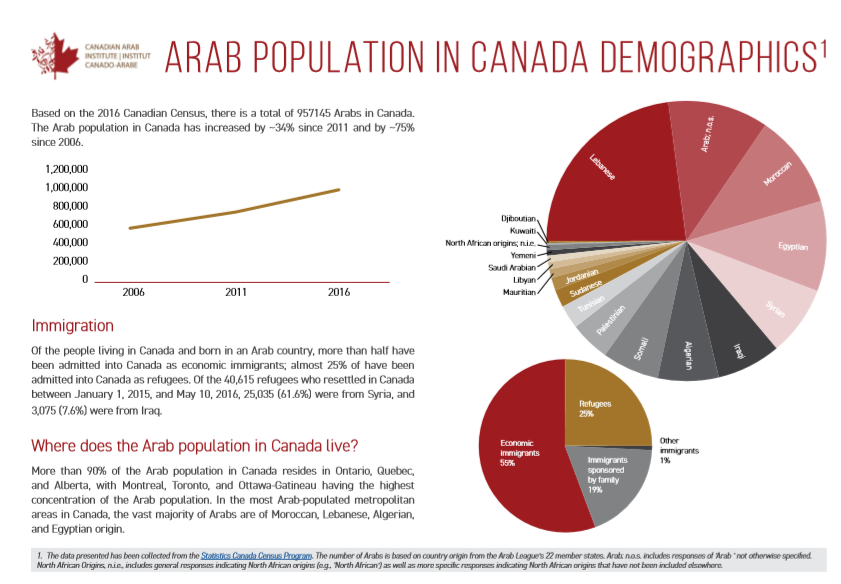
The purpose of this report is to provide information about the Arab population in Canada. The data presented in this report has been collected from the Statistics Canada 2016 Census of Population Program data, with a focus on the Immigration and Ethno-cultural Diversity topic in order to understand the distribution and demographics of the Arab population in Canada. This report examines the Arab population from various perspectives, including, but not limited to, age, gender, education, fields of study, and labour force.
Where Arab country origin data was available, data relating to the 22 member states of the Arab League was collected and used. The 22 members of the Arab League are Algeria, Bahrain, Comoros, Djibouti, Egypt, Iraq, Jordan, Kuwait, Lebanon, Libya, Mauritania, Morocco, Oman, Palestine, Qatar, Saudi Arabia, Somalia, Sudan, Syria, Tunisia, the United Arab Emirates, and Yemen.
In some instances, data related to Arabs was collected from products that included “Arab” as a visible minority. According to Statistics Canada, visible minority refers to whether a person belongs to a visible minority group as defined by the Employment Equity Act and, if so, the visible minority group to which the person belongs. The Employment Equity Act defines visible minorities as 'persons, other than Aboriginal peoples, who are non-Caucasian in race or non-white in colour'. As such, and in accordance with the employment equity requirements, if a person reported being 'Arab' and 'White’, they would have been excluded from the Arab visible minority population. Also, if a person reported being ‘Arab’ and provided a European write-in response such as ‘French’, they would have been excluded from the Arab visible minority population as well[1]. The exclusion of some Arabs from the Arab visible minority population count significantly reduces the number of individuals in the Arab visible minority population.
The data presented in this report is accompanied by footnotes to clarify whether the data has been collected using Arab country origins or if it’s based on the Arab visible minority population count.
 DOWNLOAD DEMOGRAPHICS